Belgian crash highlights the legendary strength of Volvo’s flagship SUV
In a dramatic incident that has captured attention among automotive enthusiasts and safety advocates, a Volvo XC90 proved its legendary structural integrity in a high-impact head-on collision with a fire truck on a Belgian highway. The crash occurred on the morning of December 5, 2024, on the N81 road in Messancy, in the Luxembourg province of southern Belgium — approximately 150 km from Brussels.
According to local reports, the accident involved three vehicles and took place around 7:10 a.m. The fire truck, which was not on an emergency call but was being driven by a trainee accompanied by an instructor for a practical driving license test, lost control on the slippery and poorly maintained road surface. Conditions were challenging due to slight snowfall and freezing temperatures. The heavy emergency vehicle crossed the central median and collided head-on with an oncoming Volvo XC90.
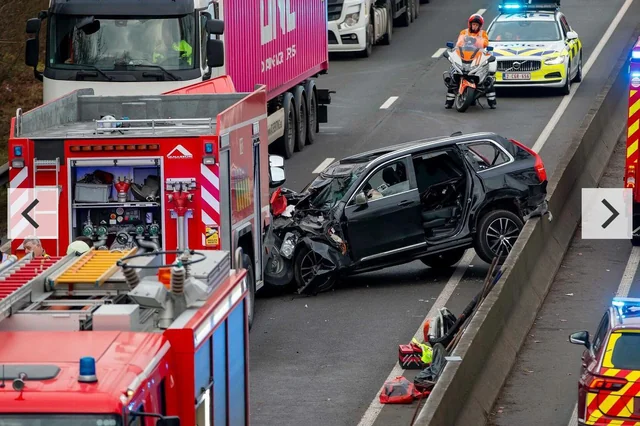
Heavily damaged front end of the Volvo XC90. The passenger cabin remained largely intact. (Photo: Local news sources)
The impact was severe. Images from the scene show significant deformation to the engine bay and front suspension of the XC90. However, the passenger cabin remained largely intact — a testament to Volvo’s renowned safety engineering, which prioritizes a rigid “safety cage” constructed from high-strength boron steel and advanced materials.
The female driver of the XC90 sustained serious injuries but was reported to be in stable condition, with her life not in danger. Injuries were also reported among occupants of the fire truck, though no fatalities occurred in what could easily have been a catastrophic event given the mass of the laden fire engine.
This real-world incident adds to the XC90’s storied reputation for occupant protection. Since its introduction, the model has consistently earned top marks in crash tests from Euro NCAP and the IIHS. Volvo’s commitment to safety — rooted in the brand’s Swedish heritage and slogan “Volvo for Life” — is evident in features such as energy-absorbing crumple zones, advanced airbag systems, and reinforced side structures.
The circumstances surrounding the crash have raised questions about driver training, emergency vehicle maintenance, and Belgium’s road quality. Many drivers have long criticized Belgian highways for frequent potholes, poor drainage, and slippery surfaces in winter conditions.
The XC90, particularly in its plug-in hybrid variants, continues to set benchmarks in the luxury SUV segment. While modern SUVs face criticism for their size and weight, models like the XC90 successfully balance luxury, performance, and safety in a seven-seater package popular with families.
As investigations continue, this event will likely be studied by safety engineers and policymakers alike. For Volvo owners and prospective buyers, it provides compelling real-world evidence alongside laboratory data. In an era where electric and autonomous technologies dominate headlines, stories like this remind us of the fundamentals: robust passive safety design still saves lives.
The road was reopened after clearance, but the incident leaves a lasting impression. It highlights the critical interplay between human factors, vehicle engineering, and infrastructure. For the XC90 driver, the car’s strength offered a fighting chance — and a powerful narrative for why safety should never be compromised in automotive design.